
Trending now
Metro Line 13 Set to Transform MMR Connectivity, Unlock New Real Estate Growth Corridors
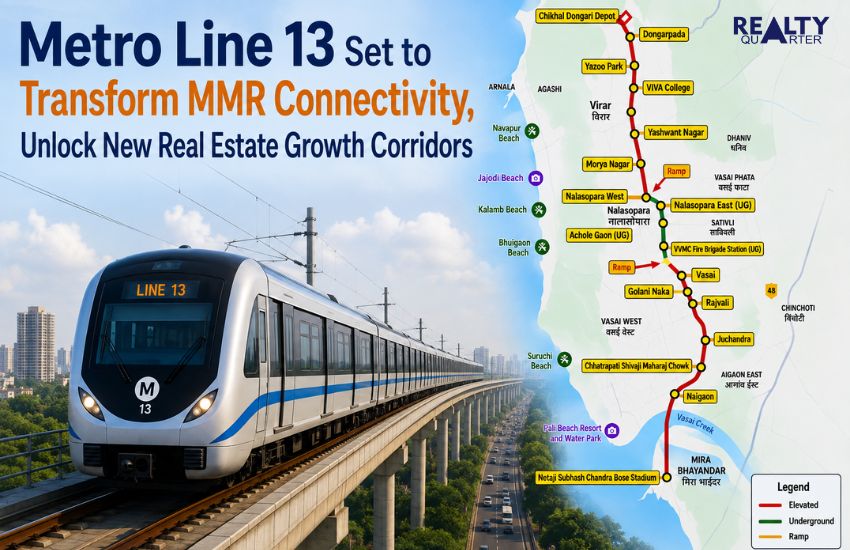
₹17,724.99 crore project to connect Mira-Bhayandar with Vasai-Virar
Maharashtra’s approval of Metro Line 13 marks a major step towards improving public transport between Mira-Bhayandar and Vasai-Virar. The 25.03-km corridor will have 16 stations and is estimated to cost ₹17,724.99 crore.
The project is expected to strengthen connections across the Mumbai Metropolitan Region (MMR), where residential areas and employment centres are expanding rapidly.
A new metro corridor
Metro Line 13 will pass through Thane and Palghar districts and will be implemented by the Mumbai Metropolitan Region Development Authority (MMRDA).
Of the total route, 21.78 km will be elevated and 3.25 km will be underground. The line will have 13 elevated stations and three underground stations.
The route will connect Mira Road, Vasai, Nalasopara, Naigaon and Virar. It will also connect with suburban railway stations at Naigaon, Nalasopara and Virar.
A proposed link with Metro Line 9 at Netaji Subhash Chandra Bose Ground in Mira Bhayandar will provide another important interchange.
Vasai Creek connection
A major part of the project is a 4.92-km integrated six-lane road-and-metro bridge over Vasai Creek, connecting Panju island.
A metro depot has also been proposed at Chikhal Dongari in Palghar district.
The combination of the metro route and the bridge is expected to make movement between the two sides of the creek easier and improve access to surrounding areas.
Last-mile support
The project will include bus services at all metro stations to improve last-mile connectivity.
Around 24.84 hectares of land will be required for the corridor. The government has set a target of completing the project within five years of approval.
Authorities have also been directed to complete land acquisition and access roads within the next six months.
Passenger benefits
Metro Line 13 is expected to carry around 4.49 lakh passengers daily by 2031.
The project is expected to reduce travel time by about 50 per cent compared with road travel. It is also aimed at reducing the use of private vehicles, easing pressure on major roads and supporting lower carbon emissions.
For daily commuters, the biggest benefit could be easier access between residential areas and important employment and commercial locations.
Impact beyond transport
Better public transport can also influence the development of areas surrounding the metro stations.
Improved accessibility may support residential projects, commercial activity, industrial movement and logistics in parts of Mira-Bhayandar and Vasai-Virar.
However, the long-term impact will depend on how well the metro is connected with buses, suburban trains, roads and pedestrian facilities.
Pune Ring Road gets approval
The Infrastructure Committee has also approved a revised project cost of ₹10,502.36 crore for the eastern expansion of the Pune Ring Road.
The Maharashtra State Road Development Corporation (MSRDC) will implement the project.
The expansion covers a 31.805-km access-controlled expressway from Sortapwadi (Valti) on the Pune-Solapur road to Varve (Budruk)-Shivare on the Pune-Satara road.
The main objective is to move inter-state and inter-city traffic away from Pune city and reduce congestion.
Pune project moves ahead
The complete Pune Ring Road project is 168.981 km long and is planned as an integrated access-controlled corridor once the entire route is connected.
Around 80 per cent of land acquisition has already been completed, with completion targeted for June 2029.
The road will have three lanes in each direction and a speed limit of 120 kmph.
It will include one interchange, three major bridges, five minor bridges, 18 viaducts or flyovers and four tunnels.
Tree plantation along both sides of the road and landscaping near the interchange are also planned.
Editor’s insight
The real importance of Metro Line 13 is not only the new route it will create, but the opportunities it can open for the areas along the corridor.
When reliable public transport reaches developing locations, distance becomes less of a barrier for residents and businesses. This can gradually influence housing demand, commercial activity and the location of future investment.
For the real estate sector, the message is simple: connectivity can create growth, but planned development must follow it.
The success of Metro Line 13 will therefore depend not only on completing the tracks and stations, but also on timely execution, strong last-mile links and proper planning around the new corridor.
By Sana khan
Executive Editor,
Realty Quarter
Mumbai
Tags: #MMRDA, #MSRDC, #Mumbai Real Estate, infrastructure projects Maharashtra, Maharashtra Metro, Metro connectivity, Metro Line 13, Mira Bhayandar Metro, Mira Road, MMR real estate, Mumbai infrastructure, Mumbai Metro Line 13, Mumbai Metropolitan Region, Naigaon, Nalasopara, Pune Ring Road, real estate growth corridors, Urban Development, Vasai, Vasai Creek bridge, Vasai Virar Metro, Virar






Our Esteem Clients:












































Channel Partner Associations:

















Our Partners:















Our Supporters: