

Trending now
₹3 Fuel Hike May Push Housing Costs Up by 5% Across Indian Cities
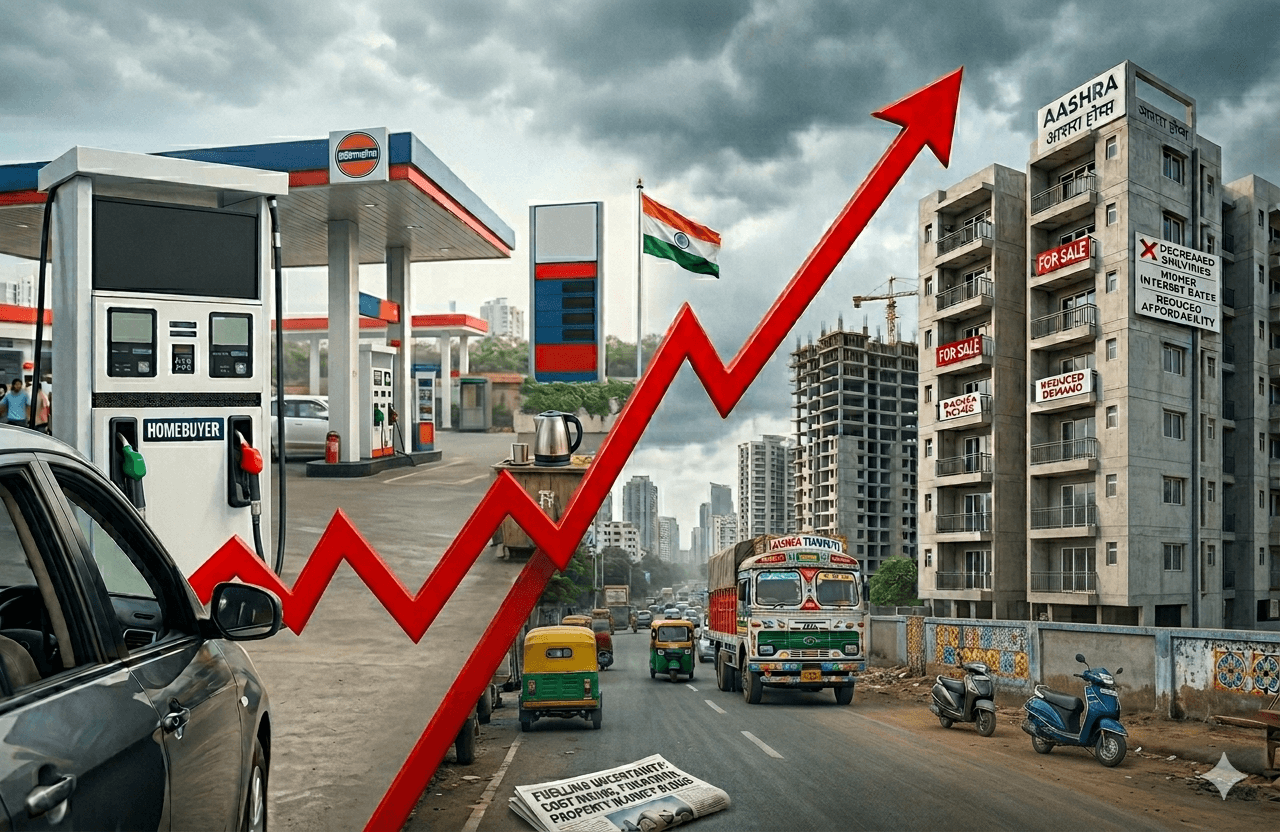
Fuel Price Surge Begins Reshaping India’s Real Estate Economics
India’s recent fuel price hike is beginning to trigger a ripple effect across the country’s real estate and infrastructure sectors, raising concerns over higher construction costs, inflationary pressure, and increasing housing prices in major cities.
Petrol and diesel prices were recently increased by up to ₹3 per litre after global crude oil prices surged amid escalating geopolitical tensions in West Asia. Brent crude oil crossed the $100 per barrel mark following disruptions in the Strait of Hormuz, one of the world’s most critical oil transit routes.
As India imports more than 80% of its crude oil requirements, the country remains highly vulnerable to global oil market fluctuations. Economists believe the latest fuel hike could add nearly 15–25 basis points to India’s retail inflation, affecting transportation, logistics, manufacturing, and infrastructure sectors.
According to the April 2026 RBI-linked market outlook and industry estimates, sustained crude oil volatility may continue to influence inflation trends, consumer spending, and borrowing costs over the coming quarters.
Construction Costs Begin Rising
The real estate sector is among the industries expected to face the strongest impact from rising fuel prices. Diesel powers heavy construction machinery, excavation equipment, and transportation vehicles responsible for moving raw materials across project sites.
Developers across Mumbai, Pune, Bengaluru, Hyderabad, and Delhi-NCR are already witnessing higher costs for steel, cement, aggregates, PVC products, electrical equipment, ceramics, and tiles.
According to a May 2026 construction outlook by JLL India, construction costs could rise between 3–5% if crude oil prices remain elevated over the next few quarters.
Estimated Construction Cost Increase by Segment
Segment-Estimated Cost Increase
- Steel-4–6%
- Cement Transportation -3–5%
- PVC & Petrochemical Products-5–7%
- Construction Logistics -4–6%
- Overall Construction Cost -3–5%
Estimated Impact of Fuel Prices on Construction
Costs -Fuel Price Rise
Estimated Construction Cost Impact
- ₹1/litre-1–2%
- ₹3/litre-3–5%
- ₹5+/litre-5–8%
City-Wise Impact Becoming Visible
Industry experts believe the impact will vary across cities depending on logistics dependency, labour costs, and project scale.
City-Estimated Construction Cost Rise
- Mumbai (MMR)-4–5%
- Pune-3–4%
- Bengaluru-3–4%
- Hyderabad-3–5%
- Delhi-NCR-4–5%
In Mumbai Metropolitan Region (MMR), redevelopment and high-rise projects are expected to witness the highest pressure because of their dependence on steel, transportation, and vertical construction equipment.
Pune’s township and mid-income projects are also witnessing rising transportation-related expenses, while Bengaluru and Hyderabad may experience higher operational costs across commercial and tech-park developments.
Industry Experts Raise Concerns
Industry body CREDAI warned that escalating fuel and gas prices are affecting the entire construction ecosystem — from raw material manufacturing to transportation and project execution.
“Fuel inflation directly impacts project viability because logistics and transportation remain core cost drivers in construction,” said Boman Irani, President of CREDAI National.
Property consultants at ANAROCK Group believe affordable and mid-income housing projects are likely to face the greatest pressure because developers in these categories operate on relatively thinner margins.
“Affordable housing remains highly sensitive to input-cost fluctuations. Sustained fuel inflation may eventually force developers to revise pricing structures,” said Anuj Puri, Chairman of ANAROCK Group.
According to market estimates from JLL India, prolonged crude oil volatility could significantly increase procurement and logistics costs if Brent crude remains above $100 per barrel over the next two quarters.
Supply Chain and Manufacturing Impact
The crisis is also affecting industries dependent on LPG and natural gas, including:
- Petrochemical-manufacturing
- PVC production
- Ceramic and vitrified tile industries
- Electrical component manufacturing
Rising energy costs and reduced production capacity are creating supply-chain disruptions, increasing procurement costs and project execution timelines across the real estate sector.
Analysts believe warehousing, logistics parks, and industrial real estate projects may also witness rising operational pressure due to increasing transportation and freight expenses.
Historical Comparison Raises Concerns
Analysts note that the current fuel price shock resembles the 2022 crude oil rally triggered by the Russia-Ukraine conflict, when Brent crude prices surged sharply and construction costs across India increased because of higher logistics and raw material expenses.
During the 2022 energy crisis, several developers revised project budgets and residential property prices in metro cities witnessed noticeable upward pressure due to inflation-linked construction costs.
Pressure on Oil Companies and Inflation
Public sector oil companies had reportedly been absorbing rising crude oil costs for months to protect consumers from sudden fuel shocks. However, continued increases in international crude prices and depletion of cheaper inventories weakened their financial position.
Industry estimates suggest state-run oil retailers were facing losses of nearly ₹10 billion per day before implementing the latest fuel price revision.
According to RBI-linked market estimates, every sustained $10 increase in crude oil prices could add nearly 20–30 basis points to inflationary pressure while impacting transportation, manufacturing, and housing affordability.
Economists believe:
- Fuel inflation may weaken consumer purchasing power
- Transportation and logistics costs are likely to rise further
- Home loan affordability could be affected
- Consumer sentiment and investment activity may slow temporarily
- Government Monitoring the Situation
Officials from the Ministry of Petroleum and Natural Gas have indicated that India is closely monitoring global oil market volatility and evaluating measures to manage domestic inflationary pressure.
Amid rising import pressure and global uncertainty, Prime Minister Narendra Modi urged citizens to adopt fuel conservation measures, including:
- Greater use of public transport
- Carpooling
- Work-from-home practices
- Online meetings wherever possible
The government also appealed to citizens to reduce non-essential overseas travel and avoid excessive gold purchases temporarily to help conserve foreign exchange reserves.
According to RBI Monetary Policy Reports and market research published by JLL India Research Reports rising fuel and logistics costs remain key risks for India’s infrastructure and housing sectors in 2026.
Long-Term Outlook Remains Stable
Despite the short-term challenges, industry experts believe India’s long-term real estate fundamentals remain supported by:
- Rapid urbanisation
- Infrastructure expansion
- Rising housing demand
- Institutional investments
- Smart-city development
According to industry estimates from ANAROCK and Knight Frank India, housing demand across major metro cities continues to remain stable despite rising input costs and inflationary pressure.
However, analysts warn that prolonged geopolitical tensions and crude oil volatility could reshape India’s real estate economics by increasing construction costs, slowing project launches, altering pricing strategies, and creating cautious buyer sentiment.
Insights
The ongoing fuel price surge has highlighted how closely India’s real estate sector is connected to global energy markets and geopolitical developments. What began as a rise in petrol and diesel prices is now steadily influencing construction economics, project planning, housing affordability, and overall market sentiment across the country.
For developers, the coming months may require a careful balance between managing rising input costs and maintaining buyer demand in an already price-sensitive market. For homebuyers, increasing inflation and higher borrowing costs could make purchasing decisions more cautious, particularly in affordable and mid-income housing segments.
At the same time, the current situation may accelerate the industry’s shift toward cost-efficient construction practices, local sourcing strategies, energy-efficient infrastructure, and stronger financial planning to withstand future market volatility.
While India’s long-term real estate fundamentals continue to remain strong due to urbanisation, infrastructure expansion, and rising housing demand, sustained crude oil volatility could temporarily reshape pricing strategies, investment patterns, and project economics across the sector.
If fuel prices continue to remain elevated, India’s real estate market may enter a phase of cautious growth, where operational efficiency, financial discipline, and strategic execution become as important as expansion and demand.
By Sana khan
Executive Editor, Realty Quarter
Mumbai







Our Esteem Clients:



























































Channel Partner Associations:





















Our Partners:


















Our Supporters: