

Trending now
Mumbai societies get wider scope for lifestyle amenities without extra FSI burden
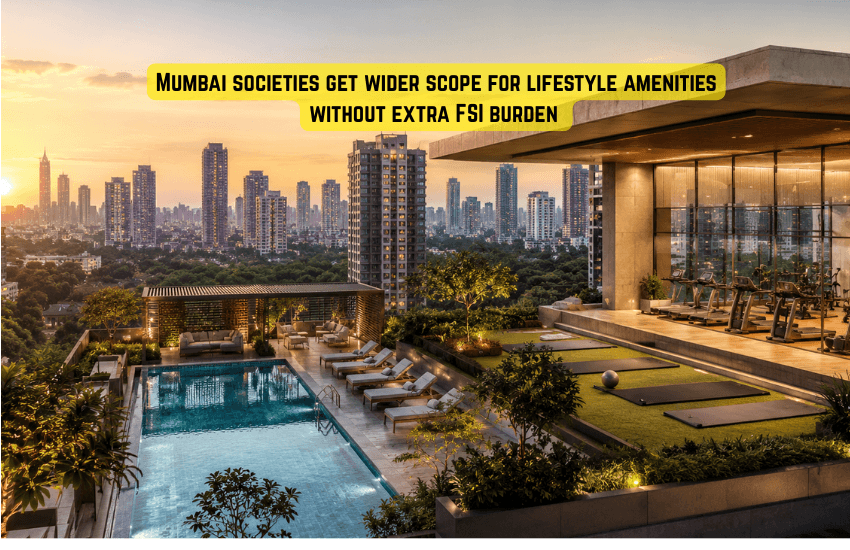
Mumbai’s residential landscape may soon witness a noticeable shift in the way housing societies design community spaces. In a significant urban planning move, the state government has increased the permissible area for recreational and wellness facilities that can be developed without attracting additional Floor Space Index (FSI) charges.
Under the revised provision, residential societies can now utilise up to 4% of the total built-up area for amenities such as yogalayas, fitness centres, meditation spaces, recreation zones, and covered swimming pools. Earlier, this limit stood at 2%.
The amendment, issued under Development Control and Promotion Regulations (DCPR) 2034 for areas falling under the BMC jurisdiction, reflects the growing demand for integrated lifestyle infrastructure within residential communities. As urban congestion and travel time continue to increase, residents today prefer wellness and leisure activities within their own gated premises rather than depending on external facilities.
The notification also specifies that if the recreational utility area exceeds the 4% threshold, the excess portion will be counted under FSI norms. Additionally, the minimum size prescribed for a yogalaya or fitness centre has been fixed at 323 square feet.
Industry observers believe the change acknowledges the evolving expectations of modern homebuyers. Large residential communities today are no longer limited to basic clubhouses. Developers are increasingly focusing on holistic living environments that include wellness spaces, activity zones, fitness infrastructure, and social interaction areas.
As real estate consultant Sandip Isore observed, “Gated communities with 50-100 flats are coming up all over and residents want all kinds of facilities within their gates to enhance the joy of living. Initially there was only the clubhouse but in the last 8-10 years several recreation activities have been added and given the traffic jams on the city roads, people prefer to have these activities in the society itself.”
The policy also introduces greater clarity regarding ownership and usage rights. According to the notification, these amenities will remain under the ownership of the housing society or apartment owners’ association, reducing the possibility of commercial misuse or ownership-related disputes in the future.
Another notable aspect of the amendment is its extension to commercial and office developments. Such projects will also be allowed to create similar recreational facilities, although a 100% premium linked to the Ready Reckoner Rate (RRR) will apply.
The move has also been welcomed by planning and architectural professionals who believe it could improve the qualitative value of residential developments across Mumbai. Architect Milind Changani stated, “This greatly helps smaller developers who can now provide recreational activities like basketball courts as it would be free of FSI. For the first time commercial buildings too can now provide this facility. This will improve the qualitative aspect for a resident multifold times.”
Insights
The latest amendment reflects how urban housing is gradually moving beyond the concept of mere residential construction toward community-centric living. As space constraints continue to define Mumbai’s growth, integrated wellness and recreational infrastructure are becoming essential rather than optional.
By allowing larger amenity spaces without additional FSI pressure, the government appears to be encouraging healthier and more self-sustained residential ecosystems. In the long run, such policy changes could reshape buyer expectations, enhance project livability, and redefine the standards of urban community development in Mumbai.
By Sana khan
Executive Editor, Realty Quarter
Mumbai






Our Esteem Clients:



























































Channel Partner Associations:





















Our Partners:


















Our Supporters: