
Trending now
SRA Drops 181 Joint Venture Slum Redevelopment Projects Across Mumbai
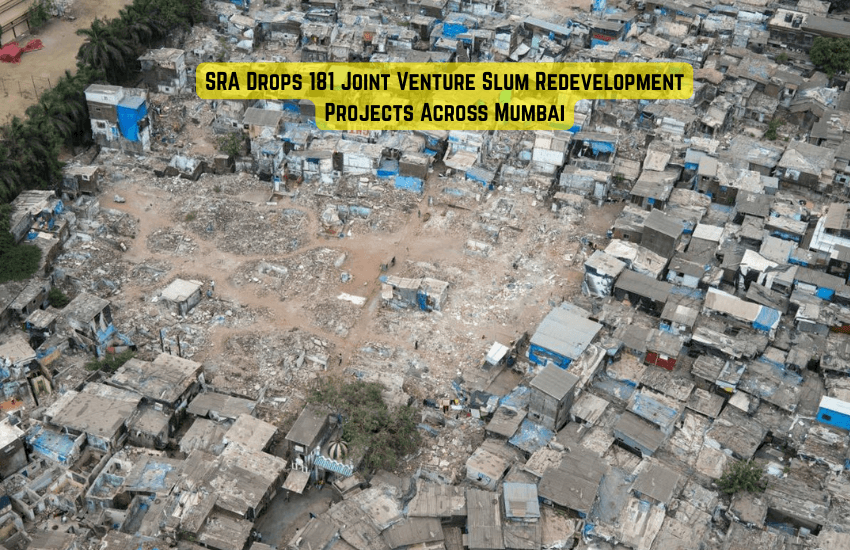
In a major policy shift that could redefine Mumbai’s slum redevelopment strategy, the Slum Rehabilitation Authority (SRA) has scrapped 181 out of 228 joint venture (JV) redevelopment projects that were earlier planned in partnership with multiple state-run agencies.
The decision comes nearly two years after the Maharashtra government initiated a large-scale redevelopment model involving agencies such as BMC, Mhada, MMRDA, MSRDC, MahaPreit, MIDC and CIDCO for the rehabilitation of slums situated on government land across Mumbai.
However, due to limited progress, implementation hurdles, and feasibility concerns, a majority of the proposed projects have now been withdrawn from the JV framework and returned to SRA for redevelopment under alternate schemes.
Of the originally proposed projects, BMC will now continue with only 44 out of its planned 77 schemes, while Mhada will retain two out of 24 and MMRDA only one out of five. The remaining projects are expected to be redeveloped directly under SRA-led mechanisms, including cluster redevelopment models and other rehabilitation frameworks, depending on future state government approvals.
SRA CEO Mahindra Kalyankar acknowledged that many of the projects failed to move beyond the planning stage and several were found to be financially or structurally unviable.
“The projects were not feasible in many cases. So now, the JV scheme has been scrapped, barring a few with BMC, Mhada and MMRDA. The rest of the proposed JV schemes are back with SRA and will be redeveloped either under the new cluster redevelopment scheme or through any other SRA scheme as decided by the state govt. Only 47 schemes have been retained under JVs,” he said.
Officials further indicated that several JV projects overlapped with proposed slum cluster redevelopment zones. Once approved by the high-powered committee constituted under the additional chief secretary (housing) and subsequently cleared by the state government, these projects are expected to move forward under revised redevelopment structures.
The original government resolution had assigned state-run agencies the responsibility of appointing architects, preparing feasibility studies and detailed project reports, conducting biometric surveys of slumdwellers, arranging transit accommodation, and constructing rehabilitation buildings.
Despite these responsibilities being formally allocated, officials admitted that most projects failed to witness meaningful execution progress through the JV route.
“But none of the schemes made any significant progress through the JV partner agencies,” the government resolution stated.
The scale of the issue remains substantial. Officials noted that all 228 slum projects had remained stalled for several years, directly affecting nearly 2.2 lakh families residing in slums located on government land across Mumbai.
The rollback of such a large number of projects highlights the broader structural challenges facing Mumbai’s rehabilitation ecosystem, including land feasibility constraints, financial viability concerns, overlapping jurisdictions, administrative delays, and execution bottlenecks among multiple government agencies.
At the same time, the move also signals a growing shift in redevelopment strategy, with authorities increasingly leaning towards cluster-based redevelopment models aimed at creating larger, more integrated urban rehabilitation zones instead of fragmented project-by-project execution.
Urban planning experts believe the decision could ultimately accelerate implementation if approvals, land aggregation, and policy coordination are streamlined under a single redevelopment authority. However, concerns remain regarding delays in rehabilitation timelines for thousands of affected families waiting for permanent housing solutions.
Insights
The scrapping of 181 JV slum redevelopment projects marks a significant reset in Mumbai’s rehabilitation strategy and reflects the growing complexity of executing large-scale redevelopment through multi-agency coordination models.
As Mumbai continues to face mounting pressure on housing, infrastructure, and urban land utilisation, the success of future redevelopment efforts may increasingly depend on faster approvals, financial feasibility, integrated planning, and single-window execution mechanisms.
For the city’s real estate and urban development ecosystem, this policy shift could become a defining moment in determining how Mumbai approaches slum rehabilitation, cluster redevelopment, and public land transformation in the years ahead.
By Sana khan
Executive Editor, Realty Quarter
Mumbai







Our Esteem Clients:
























































Channel Partner Associations:


















Our Partners:


















Our Supporters: