
Trending now
Delhi Master Plan 2047 Opens 200 Sq Km for Planned Real Estate Expansion
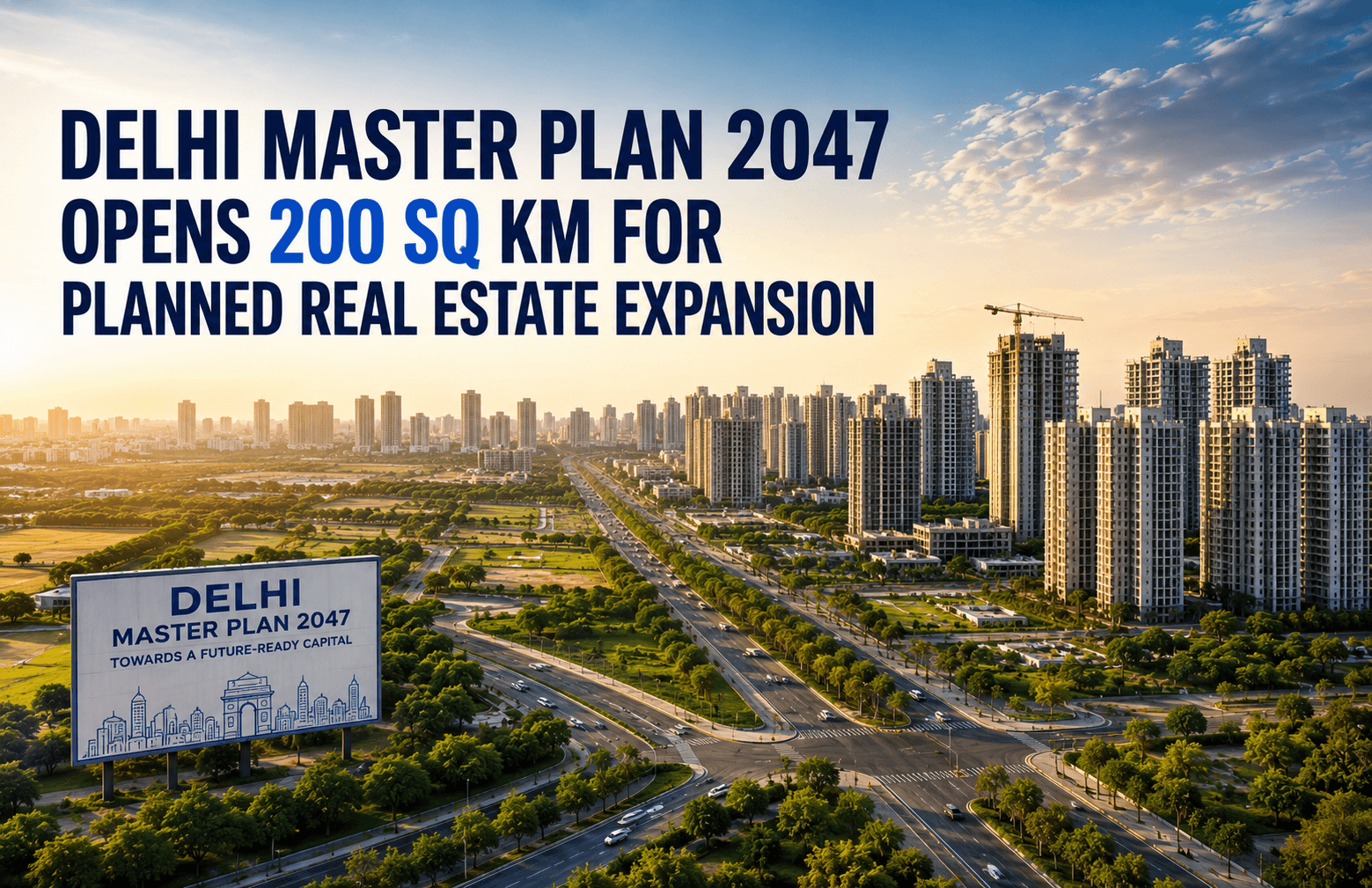
New Delhi: Delhi’s newly notified Master Plan 2047 is set to reshape the capital’s future urban growth, with nearly 200 sq km of urban extension areas identified for planned development through land pooling and infrastructure-led expansion.
The plan, notified by the Centre on August 20, 2026, provides a long-term framework for expanding Delhi while attempting to link new development with roads, public transport, housing and other urban infrastructure.
One of the major components of the plan is the development of urban extension areas through land pooling and Town Planning Schemes. The approach is aimed at bringing large parcels of fragmented land into planned development rather than allowing uncoordinated construction to spread across the city’s outskirts.
600-Km Road Network to Support Expansion
Infrastructure is expected to play a central role in the proposed expansion. The plan provides for a road network of around 600 km, intended to improve connectivity between existing parts of Delhi and emerging development areas.
The Urban Extension Road-II (UER-II) corridor is also expected to become an important development axis, with the plan providing for high-density and mixed-use development along major transport corridors.
For the real-estate sector, improved connectivity could increase the development potential of areas currently located on Delhi’s urban periphery. Better road access and planned infrastructure can also influence where residential, commercial and mixed-use projects are concentrated.
Land Pooling Could Add Large Housing Supply
Housing is another major component of MPD-2047. The plan envisages approximately 12 lakh new homes through land pooling, while its broader housing strategy targets around 40 lakh affordable housing units through different development and redevelopment mechanisms.
The scale of the proposed housing supply could have a significant impact on Delhi’s future residential market. Bringing additional land into the formal development framework could create opportunities for both private developers and public housing agencies, while potentially reducing pressure on already-developed areas.
However, the success of the land-pooling model will depend on how quickly landowners, development agencies and infrastructure providers can coordinate the implementation process.
New Growth Areas for Real Estate
The plan could gradually shift the focus of Delhi’s real-estate market towards emerging urban extension zones. Areas that gain road connectivity and supporting infrastructure are likely to become more attractive for residential and commercial development.
At the same time, planned expansion could help Delhi address some of the challenges associated with unplanned peripheral growth by integrating housing with transportation and essential infrastructure.
For developers, the key opportunity will therefore not simply be access to additional land, but the creation of well-connected and infrastructure-supported development clusters.
Implementation Will Determine the Impact
While MPD-2047 establishes the framework for Delhi’s long-term expansion, its real impact on the property market will depend on implementation.
Land pooling, road construction, infrastructure financing, approvals and coordination between multiple agencies will determine how quickly the identified areas move from planning to actual development.
If implemented effectively, the plan could create new residential and commercial hubs beyond Delhi’s established neighbourhoods and significantly expand the city’s formal development footprint over the coming decades.
For the real-estate industry, MPD-2047 therefore represents more than a planning document. It could become a roadmap for where Delhi’s next generation of housing, commercial activity and urban infrastructure will emerge.
By Sana Khan
Executive Editor, Realty Quarter
Mumbai
Tags: 12 lakh homes land pooling, 200 sq km urban extension, 600 km road network Delhi, affordable housing Delhi, commercial development Delhi, Delhi housing development, Delhi infrastructure development, Delhi land pooling, Delhi Master Plan 2047, Delhi NCR real estate, Delhi property market, Delhi real estate expansion, Delhi real estate market, Delhi residential real estate, Delhi urban development, MPD 2047, planned development Delhi, Town Planning Schemes, Urban Extension Road II






Our Esteem Clients:






















































Channel Partner Associations:





















Our Partners:

















Our Supporters: