

Trending now
Bigger rehab homes proposed for Dharavi, but clarity still awaited
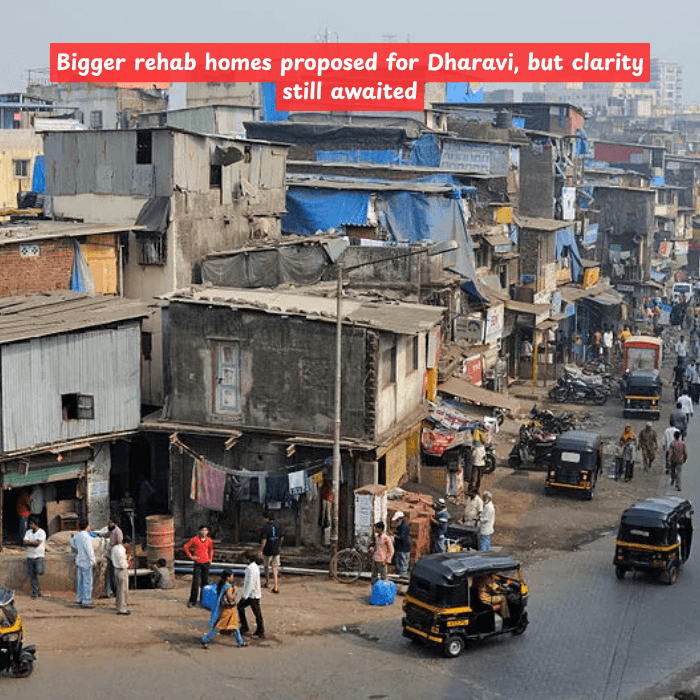
Mumbai’s redevelopment narrative is entering a more ambitious phase, with the state proposing a significant increase in rehabilitation housing sizes under the Dharavi Redevelopment Project (DRP). The revised framework offers eligible residents homes ranging from 500 sq ft to 754 sq ft carpet area, marking a notable jump from the earlier 400 sq ft provision that had faced strong resistance.
The proposal is expected to benefit nearly 8,700 households within the notified Dharavi area, including occupants of chawls and formal housing societies. The move signals a policy shift—one that attempts to address long-standing concerns around liveability, dignity, and space in one of Asia’s most densely populated urban clusters.
Policy push with structural conditions
The revision follows directions issued during a high-level review led by Chief Minister Devendra Fadnavis, where authorities were asked to justify the feasibility of increasing minimum housing size. Accordingly, the DRP submitted a plan proposing 500 sq ft carpet area (370 sq ft base + 35% fungible area), with a key rider: developers will not be eligible for incentive FSI on the fungible component.
Importantly, this revised provision does not extend to all slum dwellers under DRP, creating a distinction that could influence stakeholder expectations and negotiations going forward.
Regulatory alignment underway
To operationalise the change, the urban development department has initiated amendments to Regulation 33(9)(A) under DCPR 2034, inviting public objections and suggestions. This step indicates that while intent is clear, the policy is still evolving within the regulatory framework.
Ground sentiment: optimism meets uncertainty
Despite the improved housing offer, residents remain cautious. The absence of a publicly detailed master plan continues to raise concerns around execution, relocation, and transparency.
“The master plan for Dharavi has still not been publicised. We do not know what exactly is the plan. Where shall we be rehabilitated, will we be given homes in Dharavi, Matunga or elsewhere? The slums are being evicted when they promised key-to-key rehabilitation. There is an atmosphere of fear, there is no transparency,” said Reedan Fernando, coordinator, DRP Sector 1 Rahiwasi Kruti Sangh.
Another resident perspective reflects conditional acceptance tied to location clarity and final execution.
“Since 2004 our demand has been that we must be given 750 sq ft flats. If that is what the govt is offering us in Dharavi itself, then we have no objections,” said Rajesh Sharma.
Execution realities: scale vs displacement
Officials indicate that 11,000 rehabilitation units are currently being developed in Phase I on railway land. However, the land is not vacant, necessitating temporary relocation of existing occupants. While authorities maintain that this is a phased requirement, sources suggest that temporary displacement may extend across the entire project lifecycle.
The larger picture
The revised housing size is undoubtedly a progressive step, aligning Dharavi’s redevelopment with evolving urban standards. However, the real test lies beyond policy announcements. A larger carpet area, while politically and socially significant, does not automatically translate into improved quality of life unless backed by clear rehabilitation timelines, location certainty, and infrastructure readiness.
From a market and planning perspective, the restriction on fungible FSI incentives could impact developer viability, potentially making execution slower or more selective. At the same time, temporary relocation—if extended beyond Phase I—may create social resistance and trust deficits, which have historically delayed large-scale redevelopment projects in Mumbai.
The project, therefore, sits at a critical intersection of policy intent vs on-ground delivery. For Dharavi’s transformation to succeed, the focus must now shift towards transparency, stakeholder alignment, and execution discipline.
Because in projects of this scale,
the question is no longer just about how much space is being offered—
but where, when, and under what conditions people will actually receive it.
By Sana Khan
Executive Editor, Realty Quarter
Mumbai








Our Esteem Clients:



























































Channel Partner Associations:





















Our Partners:


















Our Supporters: