

Trending now
MMRDA’s 216-acre Raigad move signals a deeper shift in Mumbai 3.0 strategy
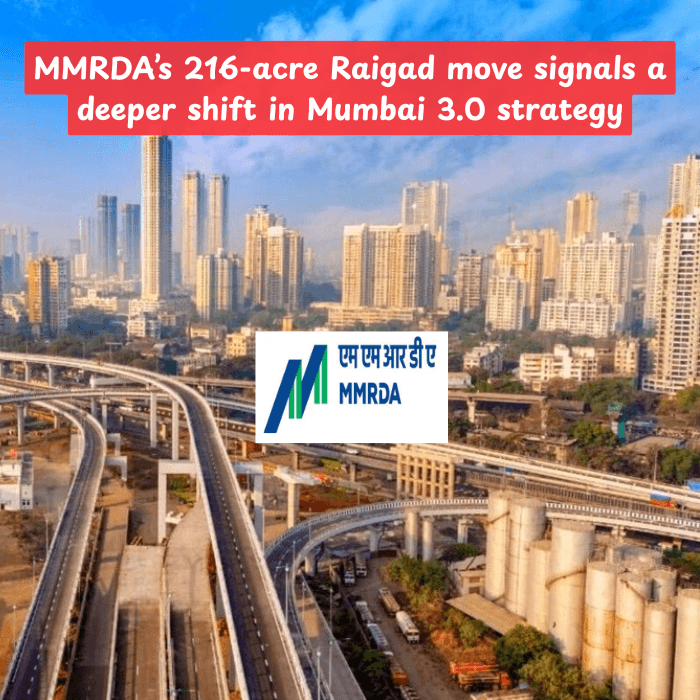
Mumbai’s next phase of urban expansion is beginning to take clearer shape, with the Mumbai Metropolitan Region Development Authority (MMRDA) securing 216 acres in Raigad. While the scale itself is notable, the more significant story lies in the model being adopted — one that repositions landowners from passive sellers to active stakeholders in the development process.
Located within the Raigad-Pen growth corridor, this aggregation marks an early but decisive step in operationalising the Mumbai 3.0 vision. More importantly, it reflects a transition from traditional land acquisition practices to a participatory framework built on consent, collaboration, and long-term value sharing. In many ways, this is not just reform, but a strategic reframing of land acquisition itself — where partnership replaces resistance as the core narrative.
“Mumbai 3.0 represents a new chapter in urban development, one that is truly for the people and by the people. Through this participatory model, we are not just acquiring land, but building trust and creating a framework where citizens become partners in development,” said Maharashtra Chief Minister Devendra Fadnavis.
At its core, this approach signals a structural shift — from acquisition to alignment. By prioritising mutual consent and offering multiple compensation pathways, MMRDA is attempting to address one of India’s most persistent urban challenges: land resistance and delayed execution. Here, trust is not merely a sentiment, but an operational tool — one that is actively unlocking land and accelerating timelines. What is unfolding in Raigad is not merely land aggregation, but a calibrated shift in how urban India negotiates growth — replacing coercion with consent, and resistance with alignment. The real innovation lies not in scale, but in psychology.
The response from landowners appears to validate this strategy. The signing of a shareholders’ agreement has transitioned the project from planning into execution, indicating both administrative momentum and growing stakeholder confidence.
According to Maharashtra Deputy Chief Minister and MMRDA Chairman, Eknath Shinde, the strong participation reflects increasing trust in the model. The framework offers multiple compensation routes — including mutual consent-based acquisition under the Maharashtra Regional and Town Planning Act, 1966, development rights such as floor space index (FSI) and transferable development rights (TDR), and a land pooling structure that assures a 22.5% return of developed land. This effectively converts landowners into long-term value participants rather than one-time beneficiaries, subtly shifting part of the market risk — and upside — onto them.
“The response to our participatory land acquisition policy has been encouraging. Securing 216 Acres in such a short span reflects the confidence of citizens in this model. Mumbai 3.0 is being shaped as a people-driven development, where landowners are co-creators of a new urban future. This milestone gives us the momentum to accelerate implementation on ground,” said Sanjay Mukherjee, Metropolitan Commissioner, MMRDA.
What stands out is not merely the quantum of land secured, but the speed at which it has been consolidated — a direct outcome of policy design aligning with stakeholder incentives rather than just administrative execution. It reflects a level of institutional confidence and political backing that has enabled faster alignment of fragmented land parcels, historically one of the biggest bottlenecks in large-scale development.
Strategically, the Raigad Growth Centre is being positioned as more than an extension of Mumbai — it represents a deliberate decentralisation strategy aimed at redistributing economic activity beyond the city’s saturated core. Backed by proximity to major infrastructure projects such as the Atal Setu, Navi Mumbai International Airport, and the Virar-Alibaug Multi-Modal Corridor, the region is being primed as a future-ready economic hub. The sequencing here is critical — infrastructure visibility is driving land aggregation, reducing speculative risk and enhancing investor confidence.
The vision extends well beyond real estate. Plans outline an integrated urban ecosystem with dedicated districts for technology, financial services, global capability centres, data centres, microelectronics, IT/ITeS, healthcare, and logistics — supported by robust social infrastructure. This positions Mumbai 3.0 not just as a development project, but as a long-term economic engine.
The projected generation of more than 200,000 highly skilled, well-paid direct jobs, alongside substantial indirect employment, further reinforces this positioning. It signals a calibrated effort to attract both foreign investment and domestic capital while strengthening the region’s economic base.
Insights
This initiative marks a shift in control—from fragmented, dispute-prone land ownership to a more centralised, policy-driven urban expansion framework. It signals the emergence of institutions not just as regulators, but as orchestrators of large-scale city building.
The 216-acre milestone is less about scale and more about signalling—indicating that land consolidation at this level is achievable when backed by political clarity and institutional coordination. It reflects a system beginning to prioritise execution feasibility alongside planning ambition.
The compensation structure introduces a hybrid economic model, where land is no longer a one-time transaction but part of an extended value chain. This alters traditional exit dynamics and embeds landowners within the long-term performance of the project.
The locational strategy underscores a clear intent to align land aggregation with infrastructure readiness. By positioning development alongside existing and upcoming connectivity corridors, the model reduces early-stage uncertainty and strengthens its investment proposition.
However, the distribution of value remains a critical variable. The model’s long-term credibility will depend on whether smaller landholders are able to participate meaningfully, or whether advantages remain concentrated among those with larger holdings.
The framing of Mumbai 3.0 as a job-generating economic ecosystem reflects a shift in narrative—from real estate-led growth to employment-led urbanisation. This positioning is key to attracting sustained institutional and policy support.
Execution, however, remains the defining risk. The success of this framework will depend on consistency in governance, adherence to timelines, and the ability to maintain alignment across multiple stakeholders over extended project cycles.
Ultimately, this is not just a regional development—it is a structural test of how India builds its next generation of cities. Its success will depend not on intent, but on delivery.
Mumbai doesn’t lack land—it has long lacked execution. This time, the city will be watching if intent finally translates into delivery.
By Sana Khan
Executive Editor, Realty Quarter
Mumbai
Tags: Atal Setu connectivity, Devendra Fadnavis Mumbai 3.0, Eknath Shinde infrastructure development, Land pooling model India, MMRDA Raigad development, Mumbai 3.0, Mumbai Metropolitan Region Development Authority (MMRDA), Participatory land acquisition, Raigad growth corridor, Sanjay Mukherjee MMRDA, Urban expansion Mumbai, Virar-Alibaug corridor







Our Esteem Clients:























































Channel Partner Associations:





















Our Partners:


















Our Supporters: