
Trending now
Housing supply expands as prices climb across cities in Q1 2026
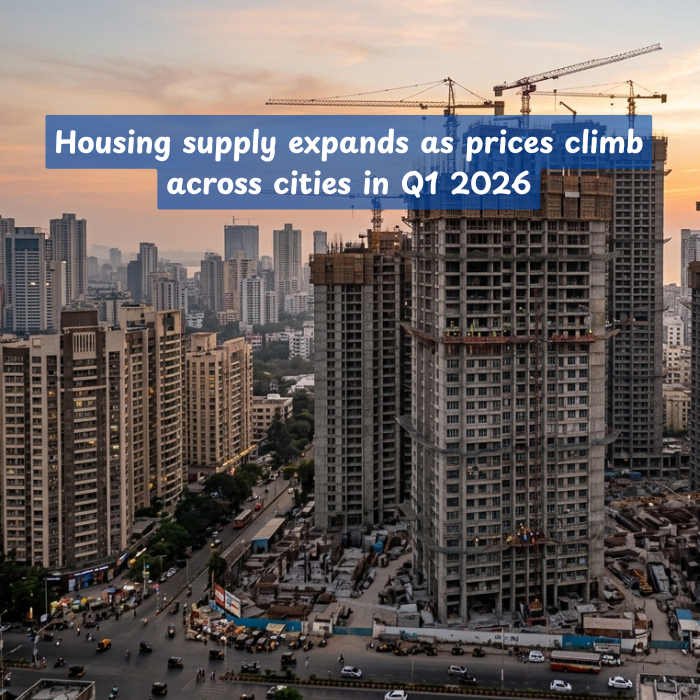
India’s residential real estate market continues to reflect a supply-led momentum, even as pricing trends remain firmly upward. In Q1 2026, housing supply recorded a 10.1% year-on-year increase, while property prices rose 14.1% across major cities, indicating a widening gap between availability and affordability.
Active listings across 13 key cities grew 6.8% quarter-on-quarter and 10.1% annually, crossing the 1.1 lakh units mark during the January–March period. This expansion pushed the average residential price to ₹14,633 per sq ft, highlighting sustained pricing strength despite moderating demand.
On the demand side, the market showed signs of sequential softening, declining 2.2% quarter-on-quarter. However, on an annual basis, demand remained relatively stable with a 1.5% increase, translating into an estimated 31.7 lakh units. This suggests that while short-term sentiment may be adjusting, underlying demand fundamentals remain intact.
City-level performance reflected mixed trends. Noida, Chennai, and Kolkata witnessed sharper demand contractions during the quarter, while Ahmedabad emerged as a growth market. Delhi and Pune reported marginal softening, pointing towards a cautious buyer approach in select urban pockets.
From a supply perspective, developers continued to push new launches, particularly in Bengaluru, Hyderabad, and Kolkata, where inventory levels saw notable expansion. This growth was accompanied by a visible shift toward premium housing, with an increasing share of supply concentrated in the ₹3 crore-plus segment.
Buyer preferences, however, remained grounded in practicality. Mid-sized configurations—especially 2BHK and 3BHK units—accounted for nearly 80% of total demand, with homes sized between 750 sq ft and 1,250 sq ft dominating transactions. This indicates a continued tilt towards functional, end-use driven purchases rather than speculative buying.
Regional variations further underline the evolving nature of the market. While NCR and southern cities such as Bengaluru and Hyderabad are witnessing demand for larger homes, the Mumbai Metropolitan Region continues to be driven by relatively smaller units due to affordability constraints.
Insights
The current market dynamic reflects a subtle but important shift—supply is expanding faster than demand is absorbing, while prices continue to rise. This creates a structurally imbalanced environment where affordability becomes a key pressure point. The growing tilt toward premium housing suggests developer confidence, but also raises questions about alignment with mass-market demand.
Going forward, the sustainability of this growth cycle will depend on how effectively the market balances pricing with real demand. If affordability continues to tighten, demand absorption may slow further, making calibrated supply and pricing strategies critical for long-term stability.
By Sana Khan
Executive Editor, Realty Quarter
Mumbai








Our Esteem Clients:






















































Channel Partner Associations:





















Our Partners:
















Our Supporters: