

Trending now
SRA tightens scrutiny on rehab buildings without OC
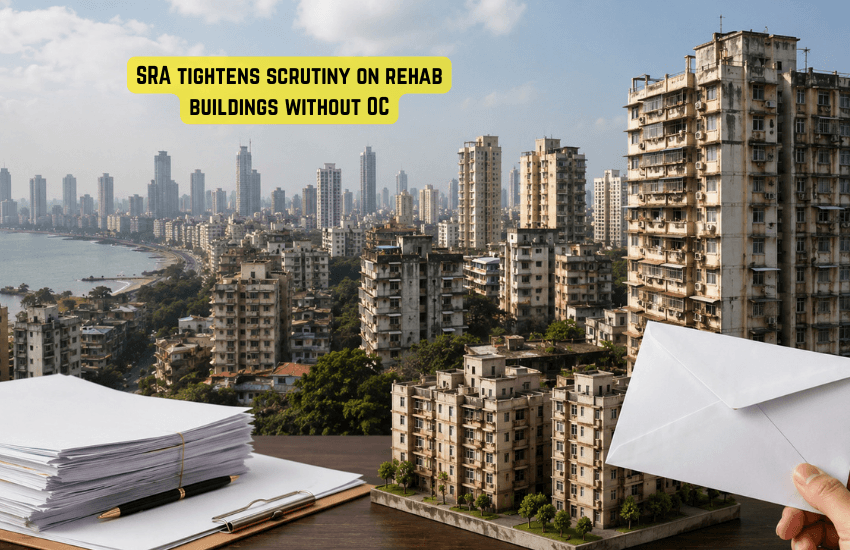
Mumbai’s Slum Rehabilitation Authority (SRA) has launched a major enforcement drive against rehabilitation buildings functioning without Occupancy Certificates (OC), exposing a serious compliance gap within the city’s redevelopment sector.
As per SRA data, 219 rehabilitation buildings spread across Mumbai’s 24 administrative wards have been handed over to eligible slum residents despite lacking mandatory Occupancy Certificates. The authority has now issued notices under Section 53(1) of the Maharashtra Regional and Town Planning (MRTP) Act, 1966, initiating legal action against such irregularities.
The move comes alongside the state government’s ongoing efforts to regularise buildings lacking OCs through a revised amnesty framework. However, officials have clarified that regularisation cannot become a shield for procedural violations that compromise residents’ safety and access to essential services.
SRA CEO Mahindra Kalyankar stated that the authority is taking a strict position against developers who hand over possession before securing statutory approvals. “SRA has started investigating such instances, and criminal cases have also been registered against some developers. After the completion of the rehab building in an SRA scheme, developers must obtain an OC. But some developers are giving possession of the rehab flats to the slum dwellers without OC,” Kalyankar said.
Officials highlighted that the absence of an OC creates long-term hardships for rehabilitation beneficiaries. In many cases, residents do not receive corpus funds meant for maintenance of the buildings, while civic amenities and infrastructure support also remain incomplete.
“Due to this, these slum dwellers do not even get corpus funds for maintaining their rehab buildings. In some cases, developers are also trying to force the slum dwellers to take possession so that they do not have to pay rent,” officials said.
The authority further observed that several rehab buildings lacking OCs are also struggling with inadequate water supply and incomplete facilities, affecting the quality of living for occupants. “It was also found that there is a lack of water and other facilities in rehab buildings due to lack of OC, so the SRA has started this crackdown.”
Under Section 53(1) of the MRTP Act, authorities are empowered to issue notices for removal or alteration of unauthorised development. Officials stated that if such structures are not regularised within the stipulated period, speaking orders may be issued after hearings, followed by demolition proceedings and criminal action where necessary.
The issue has gained wider policy attention after the Maharashtra government announced relief measures for residents living in buildings without OCs. In December, Deputy Chief Minister Eknath Shinde informed the Legislative Assembly that the Revised Occupancy Certificate Scheme would be implemented to regularise nearly 20,000 such buildings in Mumbai, benefiting more than 10 lakh residents.
Urban planning experts believe the rise in OC-related violations highlights a deeper structural issue within Mumbai’s redevelopment ecosystem, where project delivery timelines often take priority over regulatory compliance and long-term habitability standards.
Industry observers also note that delays in multi-agency approvals and infrastructure clearances continue to create operational bottlenecks for several rehabilitation projects across Mumbai.
The latest crackdown reflects a significant shift in the redevelopment narrative — from merely accelerating project completion to ensuring legal compliance, civic readiness, and accountability. Urban experts believe the action could push developers toward stricter adherence to approval timelines and improve transparency within rehabilitation housing projects.
Closing Insights
Mumbai’s redevelopment story cannot be measured only through the number of completed towers, but through the quality, legality, and dignity of rehabilitation being delivered to residents. The SRA’s action against 219 buildings without Occupancy Certificates sends a strong message that possession without compliance cannot become a normal practice within the city’s housing ecosystem.
While the government’s regularisation push may offer relief to thousands of families already residing in such projects, the larger concern remains accountability. Delayed approvals, incomplete infrastructure, and forced possession continue to place vulnerable residents at the centre of administrative and legal uncertainty.
The crackdown reflects a growing shift in policy thinking — from merely accelerating redevelopment to ensuring that rehabilitation projects meet basic civic, legal, and safety standards before handover. As Mumbai continues its large-scale urban transformation, the success of redevelopment will ultimately depend not only on construction speed, but on responsible execution and long-term livability.
By Sana khan
Executive Editor, Realty Quarter
Mumbai







Our Esteem Clients:



























































Channel Partner Associations:





















Our Partners:


















Our Supporters: